
Kinds of content
This page covers kinds of content: what they are, how Ghostwriter suggests them, and how to teach and edit them.
A kind is a type of record you write often, such as "Case study", "Service page" or "Charity partner profile". Each kind has:
- A brief: the questions Ghostwriter asks before writing one.
- Guidance: who the reader is, what each part does and in what order, how long it runs.
- A checklist: statements that must be true of a finished draft.
- Examples: records it should resemble. The writer is shown them, and their layout is followed.
Without any kinds, Ghostwriter writes from a general brief (Something else). Kinds make drafts noticeably better, because the questions and examples fit.
Suggested kinds
Ghostwriter looks through each resource's published records and suggests the kinds it finds. Suggestions appear under each resource on the Overview, as "N suggested kinds to review", and in Get started. Each card shows the kind's name and description, a line on why it's worth teaching, and up to three of the records it was found in ("For example: …").
- Learn this learns one kind from the records it was suggested from.
- Learn all N learns every suggestion for that resource, one after another. You're asked first, since each is one model call and takes about a minute.
- Not this dismisses a suggestion. Ghostwriter remembers it, and won't suggest it again.
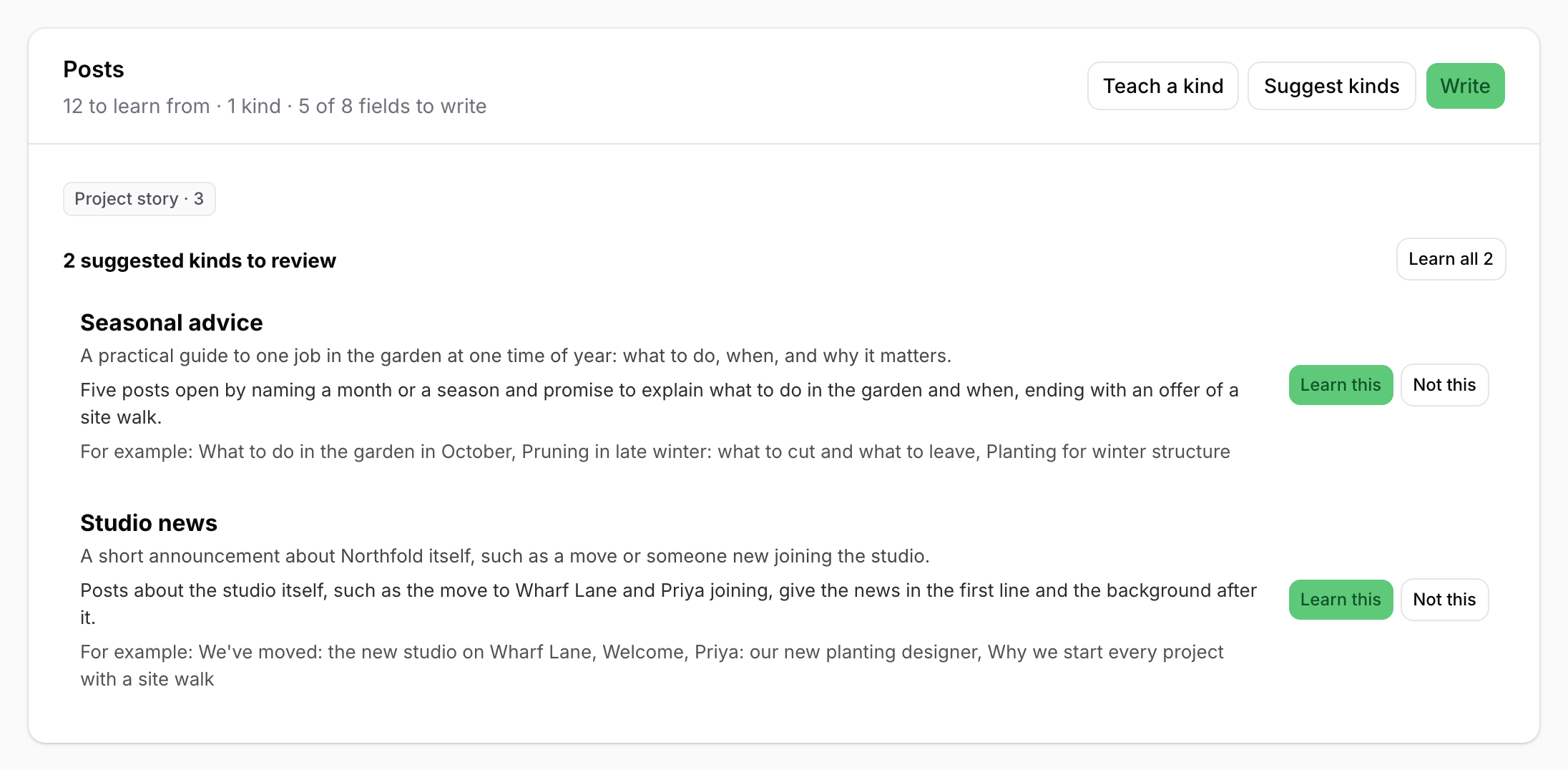
Kinds are suggested automatically only in Get started. When it opens, it looks at each resource it hasn't looked at yet, or that has ten new records since. Each look is one model call, and a resource needs at least two published records. Turn off Suggest kinds of content automatically in the settings and Get started waits for a click too.
Everywhere else, kinds wait until someone asks, so no model call happens unless someone clicks:
- Suggest kinds, beside a resource on the Overview, looks at that resource.
- Suggest kinds everywhere, at the top of the Overview, looks at every resource. It's shown when there is more than one resource.
Teaching a kind yourself
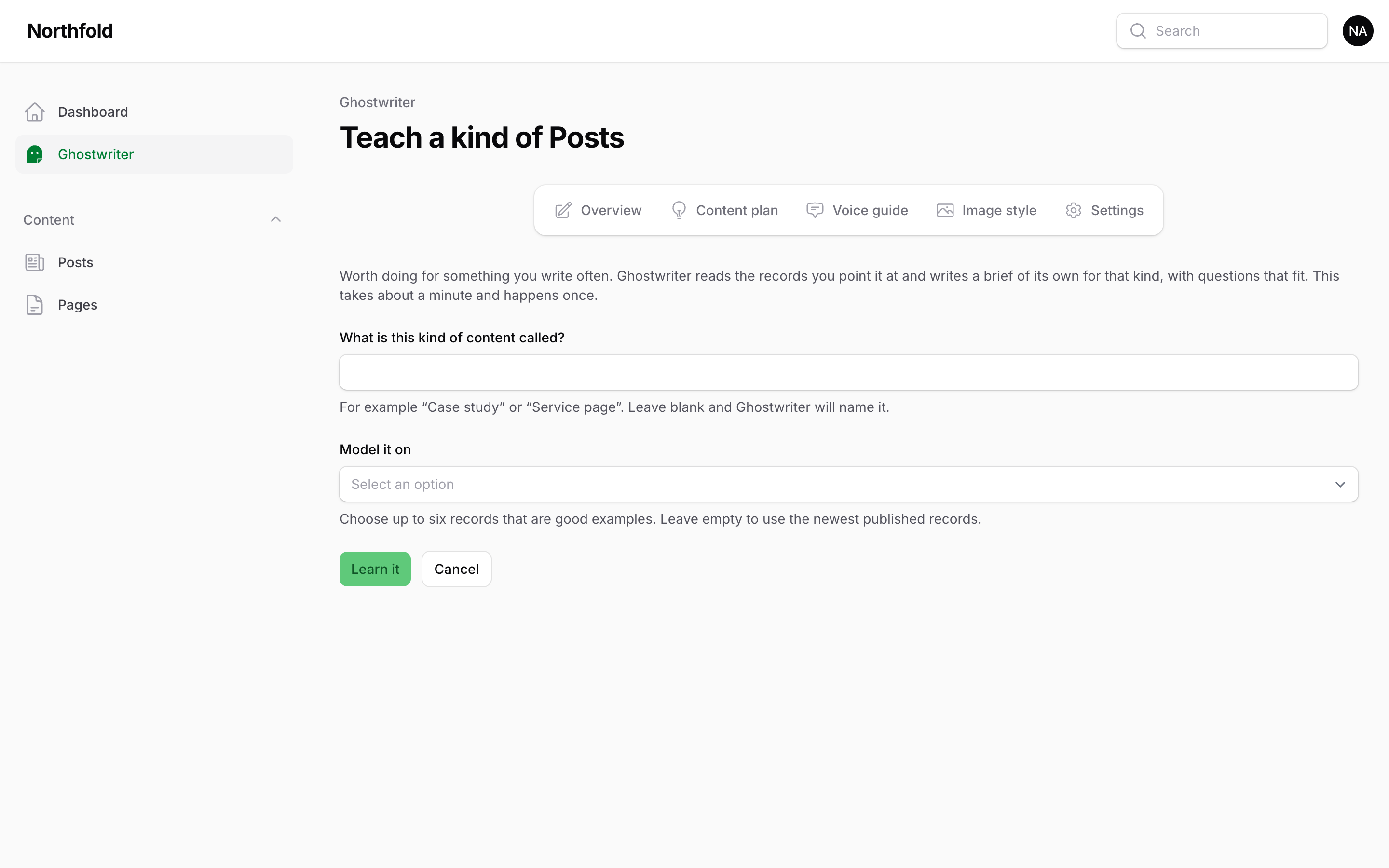
Click Teach a kind beside a resource on the Overview, or beside What are you writing? in the writing panel. The page says what teaching a kind is for; Cancel goes back to the Overview.
- What is this kind of content called? For example "Case study". Leave it blank and Ghostwriter names it.
- Model it on: up to six records that are good examples. Leave it empty to use the newest published records.
- Click Learn it.
Ghostwriter reads the resource's form and the chosen records, then writes the brief, guidance and checklist. It appears on the Overview in a minute or so.
Editing a kind
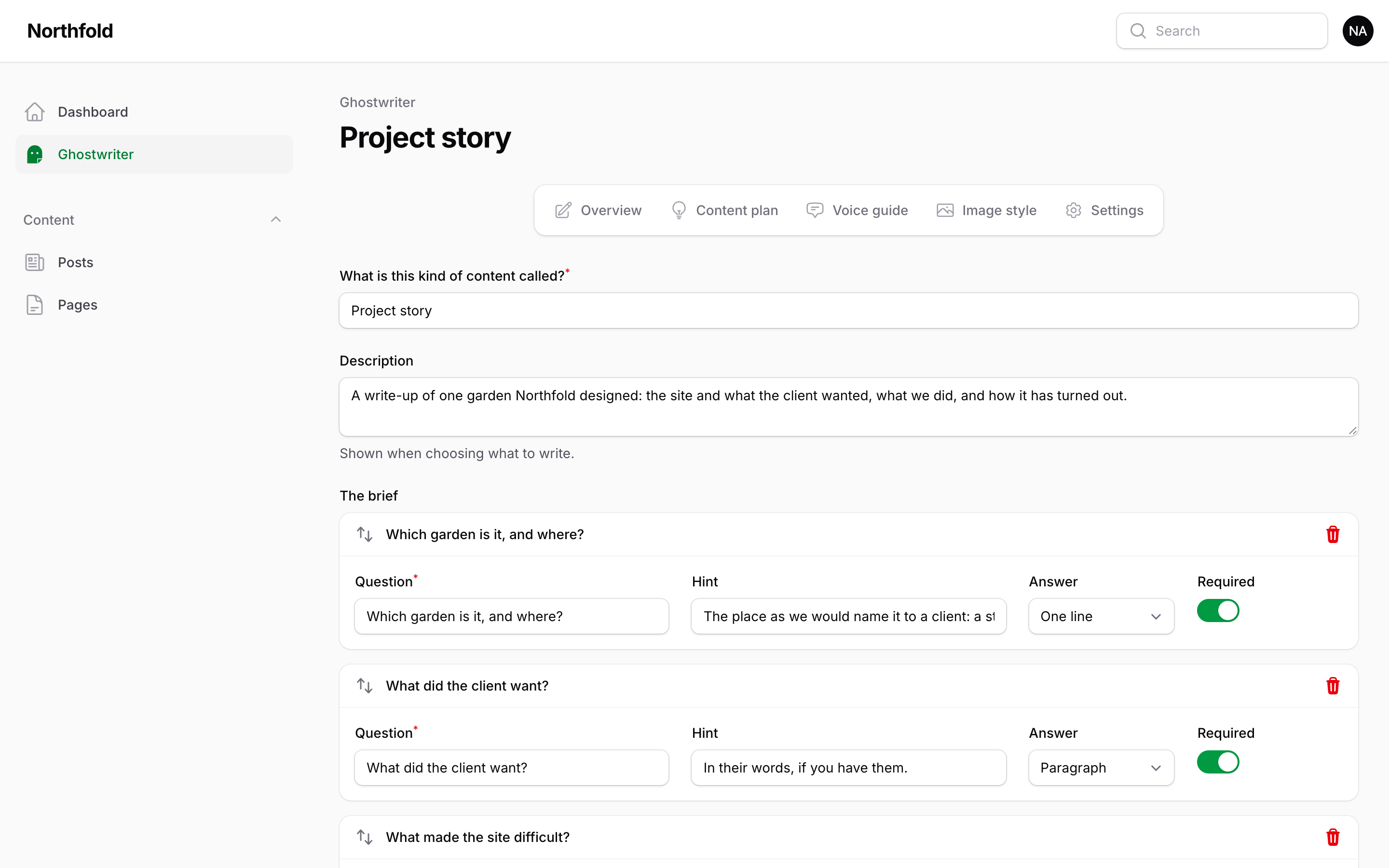
Click a kind's badge on the Overview to edit it:
- Description: shown when choosing what to write.
- The brief: each question has a label, an optional hint and answer, a length (One line or Paragraph), and whether it's Required. A kind needs a name and at least one question. Ask only for what can't be invented: what happened, who for, what resulted, what must be left out.
- Guidance for the writer: markdown. There's no need to list the fields; they're read from the form.
- Check before handing over: one statement per line.
- Modelled on: the example records.
Delete removes the kind. Records already written with it aren't affected.
Something like what is already here
Without teaching anything, the writing panel also offers Something like what is already here: groups of records built the same way (the same Builder blocks), found from the resource's own records. Choosing one starts the general brief, modelled on those records. It's shown only when a resource holds more than one shape of record. See What are you writing?
When a form changes
Kinds are learned from a resource's form as it was at the time. If the form changes, the Overview says so. Learn the kind again (or edit its guidance) if the change matters to how records are written.
Where kinds are kept
Kinds are rows in the ghostwriter_kinds table, one set per tenant on a panel with tenancy. Suggestions waiting for review, and the ones you dismissed, are kept with Ghostwriter's working state. See Where things are kept.